
Indian stock market indices closed on a mixed note, with the Sensex gaining 374 points driven by buying in Reliance Industries and ICICI Bank, while the Nifty remained flat. This divergence is attributed to a new Closing Auction Session (CAS) mechanism introduced by stock exchanges, impacting market liquidity and price discovery.

S&P Global Ratings has increased India's GDP growth forecast for the next fiscal year to 7.1 per cent, citing private consumption, investment, and exports as key drivers. However, the agency also cautioned that the conflict in the Middle East could strain India's fiscal position due to higher energy prices.

Credit rating agency Crisil observed in its report that some 'high frequency indicators go out of whack' as credit growth and service tax collections are not in tune with the CSO's growth projections.

India's fiscal deficit is projected to reach 4.5 per cent of GDP for the current fiscal year, exceeding the budgeted target, as the government's policy responses to the West Asia conflict are expected to strain public finances, according to research firm BMI.

'A balance had to be struck between the economic cost of taking action at this point against the need not to fall behind the curve in controlling inflation and anchoring inflation expectations.'

Ratings agency Crisil on Monday cut its FY14 growth forecast for India to six per cent from the earlier 6.4 per cent citing a variety of reasons, including the high lending rates, weaker pick-up in consumption and issues around mining and project clearances.
The Reserve Bank of India (RBI) has projected a 6.9 per cent GDP growth for the current financial year, citing concerns over commodity prices and supply chain disruptions stemming from the West Asia crisis.

Elaborating on its not-so-pleasing outlook on the economy, Crisil said private consumption demand, which has been the bulwark of growth for the last few decades, grew by a pale 3.1 per cent in the first quarter as against 7.2 per cent growth in the preceding quarter.
The National Council of Applied Economic Research has revised its forecast for the country's gross domestic product growth for 2006-07 to 8.44 per cent

RBI lowers GDP forecast for FY16 to 7.4%

The Centre for Monitoring Indian Economy has revised its GDP growth forecast for the current fiscal to 6.7 per cent from 6.2 per cent announced last month.

Moody's Ratings has downgraded India's growth forecast for financial year 2026-27 (FY27) to 6 per cent from 6.8 per cent, attributing the revision to weaker consumption and industrial activity, elevated energy prices, and rising input costs stemming from the West Asia conflict.

Reserve Bank Governor Sanjay Malhotra on Friday said the key policy rates will remain at low levels for a long period and may go down even further.

Reserve Bank Deputy Governor S C Murmu has highlighted the "cash paradox" where currency in circulation continues to grow despite a significant increase in digital payments. This trend complicates the RBI's forecasting and planning for currency production and distribution, prompting the central bank to seek solutions and explore ways to extend banknote life and reduce the carbon footprint of the cash cycle.
Investment bank JPMorgan has cut the GDP growth forecast for India for 2008-09 to 7 per cent from 7.5 per cent previously, citing expected moderation in industrial and service sector growth. The International Monetary Fund and Crisil have projected 8.2 per cent and 8.5 per cent GDP growth respectively. 7% is the lowest growth forecast for 2008-09 so far. JPMorgan said cut in growth expectations for India was due to US slump. It expects RBI to cut repo rate by 25 basis points.

Citing faster-than-expected recovery, rising consumer confidence and the resultant spending spike, Swiss brokerage UBS Securities has revised upwards its growth forecast for the current fiscal to 9.5 per cent from 8.9 per cent in September. The brokerage also sees the economy clipping at 7.7 per cent in FY23 but moderating to 6 per cent in FY24, as it expects the benefit of the low-interest rate regime to end by the end of FY23, and it sees the central bank hiking policy rates by 50 bps in the second half of the next fiscal. The Reserve Bank also forecasts 9.5 per cent GDP growth this fiscal while the average projection ranges from 8.5 to 10 per cent.

The Reserve Bank of India (RBI) is widely expected to keep its benchmark repo rate unchanged in the August monetary policy review, with economists citing elevated inflation risks and the pending closure of the FCNR(B) deposit scheme as key factors. Most anticipate a 'Neutral' policy stance but with a hawkish tone due to geopolitical tensions, high crude oil prices, and an uneven monsoon.

Chief Economic Advisor V Anantha Nageswaran stated that India's economy is projected to return to a 7 per cent-plus growth trajectory by 2027-28 (FY28), or sooner if external conditions improve, despite near-term challenges from the West Asia crisis.

The Reserve Bank of India (RBI) maintained its key policy rates for the fourth consecutive time, keeping the repo rate at 5.25 per cent, while the benchmark BSE Sensex closed 152 points higher in a volatile session, recovering from an intraday dip.

S&P Global Ratings projects India's economic growth to slow to 6.6 per cent in FY27, down from 7.7 per cent in FY26, citing energy stress and a potential sub-par monsoon.
Financial services major BNP Paribas on Wednesday cut India's GDP growth forecast for the current fiscal to 3.7 per cent from 5.7 per cent earlier, saying the country's 'macro muddle' is fast approaching crisis proportions.
The OECD projects India's GDP to grow at 7.6% in the current fiscal year and 6.1% in 2026-27, despite global economic challenges stemming from the Middle East conflict and energy price volatility.

India's services sector experienced its weakest growth in four-and-a-half years in July, as new business orders, both domestic and export, eased due to intense competition and declining demand. Despite a modest rebound in job creation and improved profit margins, overall business confidence slipped, reflecting a broader slowdown in the economy.

'Healthy double-digit returns are still possible, though a sharp rally is unlikely.'
India Ratings & Research (Ind-Ra) has projected the aggregate fiscal deficit of states to rise to 3 per cent of gross domestic product (GDP) in 2026-27 (FY27), from an estimated 2.8 per cent in 2025-26 (FY26), citing higher revenue expenditure amid election-related pressures and scheme cost-sharing requirements.
The World Bank has increased India's economic growth projection for FY27 to 6.6 per cent, citing resilient domestic demand, while simultaneously cutting its global economic growth outlook due to the conflict in West Asia.
The downward surprise in Q2 stemmed from a stronger-than-anticipated drag from gross fixed capital formation and marginal weakness in private final consumption expenditure. In Q3, projection errors emanated mainly from a steep unanticipated contraction in gross fixed capital formation, which was the deepest in the new series of GDP.
The Indian economy recorded a six-quarter high growth of 8.2 per cent in July-September, as factories churned out more products in anticipation of a consumption boost from the GST rate cut, according to government data.
India's economy experienced a growth of 7.8 per cent during the October-December quarter of 2025-26, according to the new series of national accounts with 2022-23 as the base year.

The IMF on Monday raised India's growth projection to 7.3 per cent for fiscal 2025-26, up 0.7 percentage point from its October forecast, on the back of better-than-expected performance of the economy. The Washington-headquartered multilateral lending agency has also revised India's Gross Domestic Product (GDP) growth forecast to 6.4 per cent for fiscal year 2026-27 beginning April 1, 2026, from its earlier estimate of 6.2 per cent.

In the first quarter of FY14, real GDP growth estimated by the Central Statistics Office stood at 4.4 per cent on a factor cost basis, and at 2.4 per cent on a market price basis, the IMF said.
Despite the rash of reform steps announced over the weekend, Standard Chartered India on Monday sharply lowered its GDP growth forecast to 5.4 per cent for FY'13 from 6.2 per cent earlier, citing slowing consumer demand, an anaemic industry and a weak services sector.
Bank of Baroda economists project India's GDP to grow 6.5-6.8 per cent in FY27 but warn that the fiscal deficit could overshoot the budgeted 4.3 per cent target, potentially reaching 4.7-4.8 per cent of GDP due to subsidy overruns, excise duty cuts, and oil marketing company losses.

The IMF's predictions for India's near-term growth may seem rosy, but the usual caveats apply - that is, we are apt to under-perform.
While the latest consensus still suggests growth will beat the rate of less than 5 per cent seen in the past two years, it does not reflect the stock market euphoria since Prime Minister Narendra Modi's historic election win two months ago.
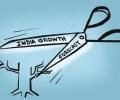
Moody's Investors Service on Thursday slashed India's economic growth projection for 2022 to 7.7 per cent, saying that rising interest rates, uneven monsoon, and slowing global growth will dampen economic momentum on a sequential basis.
A top panel of economists on Monday slashed its forecast for US economic growth this year, saying the threat of war with Iraq was dampening consumer spending and business activity.

Most members of the Reserve Bank of India's Monetary Policy Committee (MPC) expressed concerns about inflation becoming generalised and highlighted uncertainties surrounding both inflation and growth prospects due to the West Asia conflict, according to the recently released minutes.

The IMD is predicting close to a 60% probability of deficient rainfall, which means there is a strong possibility that the monsoon this year will be poor.
Differing with International Monetary Fund's growth forecast of 4.9 per cent for India during 2012, Planning Commission Deputy Chairman Montek Singh Ahluwalia said it has a statistical problem.
